When people talk about a mobile tower crane, they often focus on outreach, lifting capacity or erection time. These are measurable performance indicators that are immediately visible. But anyone who works with a mobile crane daily knows that there is one component that connects everything: the crane cab. The cab is the workplace of the crane operator. It is where comfort, ergonomics and safety come together. With the renewed Spierings crane cab, these elements have been fully integrated into one well-considered design. This development fits within the continuous innovation of Spierings mobile tower cranes, where technology is refined step by step based on practical experience. In this blog, we take you through the evolution of the Spierings crane cab, from the proven foundation of the 1990s to today’s integrated design.
In the 1990s, the focus was on what was essential at the time: reliability, visibility and direct control. The mobile tower crane had to perform under all conditions. The cab was designed as a robust, functional workplace in which simplicity and durability were key.
At that time, ergonomics was approached mainly from the perspective of control and positioning. The crane operator had to be able to work intuitively, with a clear relationship between action and crane movement. The seat, controls and sightlines were all aligned accordingly. Comfort played a role, but always in support of functionality.
This original mobile tower crane cab design proved itself in practice for many years. It formed the basis for millions of operating hours across a wide variety of projects. And because that foundation was so strong, Spierings was able to continue building on it. But the reality of the job changed. As a result, the development of the crane cab was not an aesthetic update, but a technical evolution based on changing working conditions.
Longer working days and higher demands
Projects became more complex. Inner-city construction increased. Space became tighter, margins smaller and precision requirements higher. At the same time, working days became more intensive and longer. Where a cab once mainly had to be functional, it increasingly became a working environment in which sustained concentration is essential.
This created new areas of focus:
- Support for a stable working posture
- Precisely controllable, proportional operation
- Minimisation of physical strain
- Maintaining visibility and overview throughout long working days
Ergonomics in the crane cab therefore became not only a matter of comfort, but also a matter of performance. A well-designed crane cab directly contributes to accuracy, efficiency and safety.
Stricter safety standards
The safety of the crane cab in a mobile tower crane became increasingly defined through regulations and certification. This meant that the cab design not only had to be reliable, but also demonstrably safe in terms of operation and system integration.
In practice, this led to a further refinement of the controls and safety systems. Unintended operation had to be prevented. Warning and control systems were integrated into the operator platform.
Comfort as part of long-term employability
Where comfort was once a secondary factor, it became a prerequisite for the long-term employability of the crane operator. Noise reduction, climate control and improved sightlines became important themes. A stable and well-insulated working environment supports sustained concentration and contributes to controlled lifting operations under a wide range of conditions.
Comfort in the crane cab is therefore not a luxury feature, but a technical choice within the overall design of the mobile tower crane. Safety, in turn, became not a separate addition, but a fixed part of the total system design of the cab.
What changed in the Spierings crane cab?
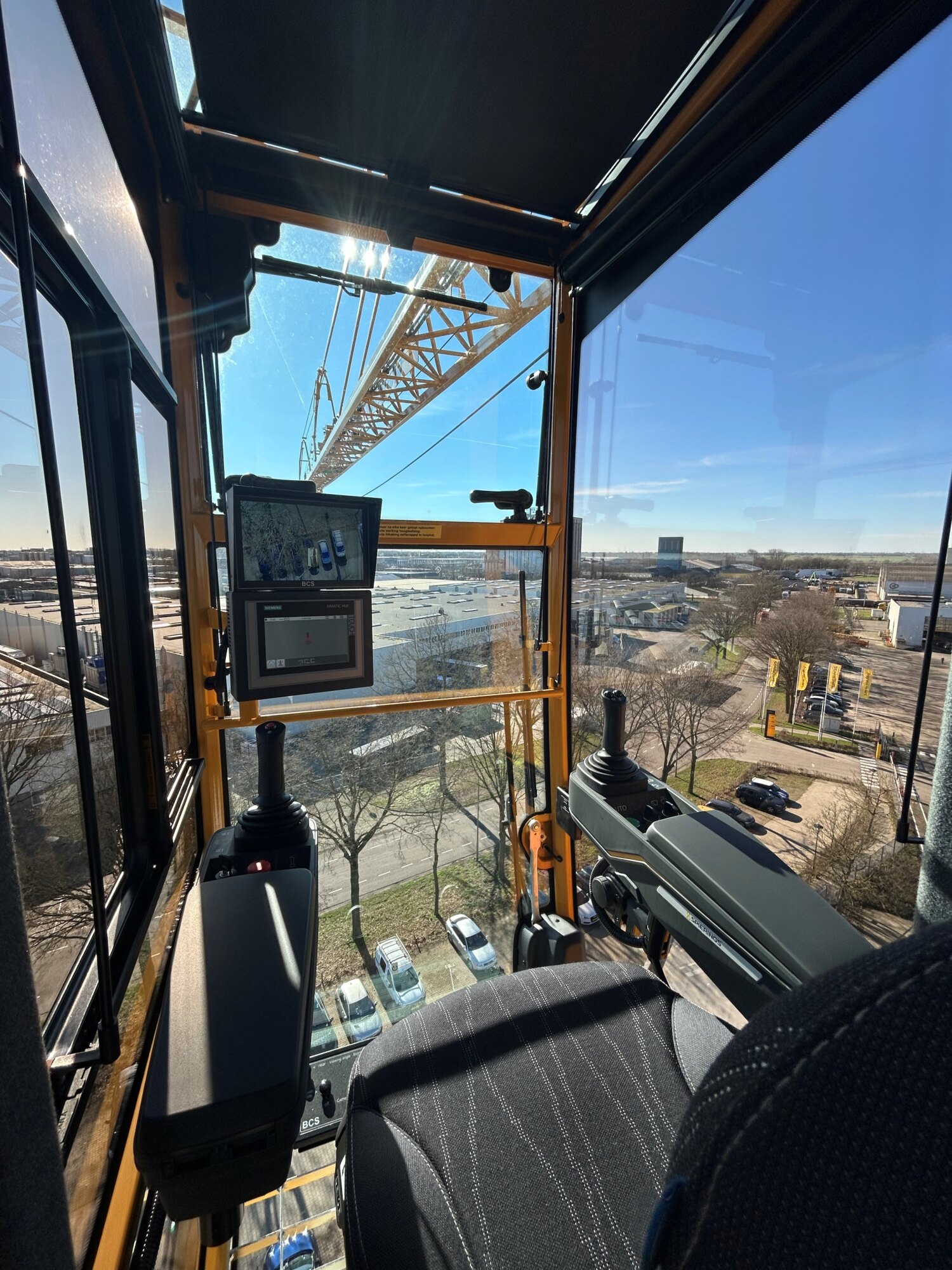
The most important changes in the cab design are:
- Larger glass surface area for improved sightlines
- A more compact screen configuration with less visual obstruction
- A fully adjustable seat with forearm support
- Integrated touch protection on the joystick
- Improved climate control and cab insulation
With the renewed Spierings crane cab, this is not a temporary update, but a fundamental step forward. The cab has been designed as an integrated system in which visibility, ergonomics, safety and climate control reinforce one another.
Visibility and spaciousness
The generous glass surface area provides clear sightlines around both the load and the working environment. By making the screen configuration more compact and positioning it deliberately, the working area remains as visible as possible. The seat is height-adjustable, allowing operators to adapt their working position to visibility and the specific jobsite situation. Visibility is therefore not a separate feature, but a starting point in the design.
Ergonomics and adjustability
The workplace has been made more widely adjustable to support stable working over long periods. A fully adjustable seat and full forearm support create a natural working posture. This supports precise control during demanding lifting operations.
Integrated safety
Safety systems have not been added afterwards but integrated directly into the controls. Touch protection on the joystick prevents unintended movements. The lift speed reduction at a height of two metres increases safety around the crane.
Climate and insulation
The renewed climate control system and improved insulation ensure a stable interior climate. Electrically heated front windows prevent misting and support direct visibility in cold or damp conditions. Climate control is therefore part of both ergonomics and safety.
Continuous development as a fixed principle
The evolution of the Spierings crane cab shows that cab development is not a standalone improvement, but a structural part of the mobile tower crane design. Innovation is not only found in major steps, but especially in the continuous refinement of systems that are used in daily practice. The cab evolves along with changing demands in the field, without abandoning its proven foundation.
Feedback from crane operators remains an important source of refinement. Not to introduce a new look every few years, but to further optimise the existing concept.
Join our community
Do you work with a Spierings crane every day? Join our Spierings Crane Operators Community: a place where operators share experiences, receive technical updates and are the first to hear about new developments. After registering, you will receive updates, practical information and news about developments within Spierings. Membership is free.
Join our Crane Operators Community