The deployment of mobile tower cranes is increasingly determined by transport regulations. Whereas lifting capacity traditionally played the leading role, factors such as transport weight, axle load and axle spacing are becoming increasingly important today. For construction companies and crane rental firms, this means that choosing a crane is no longer determined solely by its performance on the construction site, but increasingly by how well it can be transported.
When does transport become ‘exceptional’?
In almost every country, a maximum permitted gross vehicle weight applies to standard road transport. Once a vehicle exceeds this limit, it falls under special transport regulations, often referred to as exceptional transport.
This means that transport can no longer take place freely but becomes dependent on permits, designated routes and additional conditions. In many cases, driving time restrictions apply and escort vehicles may be required. This makes transport more complex and less flexible, with direct consequences for project planning.
Gross vehicle weight is only part of the equation
Although the total weight of a mobile tower crane provides an important first indication, it is not the only determining factor in practice. Regulations go beyond total weight and primarily assess how that weight is distributed.
A mobile tower crane with a relatively low gross weight may still face restrictions if the load per axle is too high. At the same time, a heavier crane may be more practical if its weight is efficiently distributed across multiple axles. It is therefore not only about how much weight is being transported, but above all about how that weight is technically supported.
The role of axle load and axle spacing in transporting a mobile tower crane
Axle load indicates how much weight is carried by each axle. In many countries, strict limits apply, often around 10 to 12 tonnes per axle. These limits are directly related to the load-bearing capacity of roads, bridges and infrastructure.
When the permitted axle load is exceeded, restrictions may apply to approved transport routes or even prevent the use of certain roads altogether. As a result, the distribution of weight across the axles has a direct impact on the operational flexibility of a crane.
In addition to axle load, the distance between the axles also plays a crucial role. Regulations take into account the relationship between axles and how the weight is distributed across an axle group.
When axles are positioned closer together, the permitted load is often lower. By optimising axle spacing, the weight can be distributed more efficiently, allowing a higher permitted load within the same transport category.
This means that it is not only the number of axles that matters, but above all the technical configuration of the carrier. As a result, two cranes with similar specifications can have completely different transport capabilities in practice.
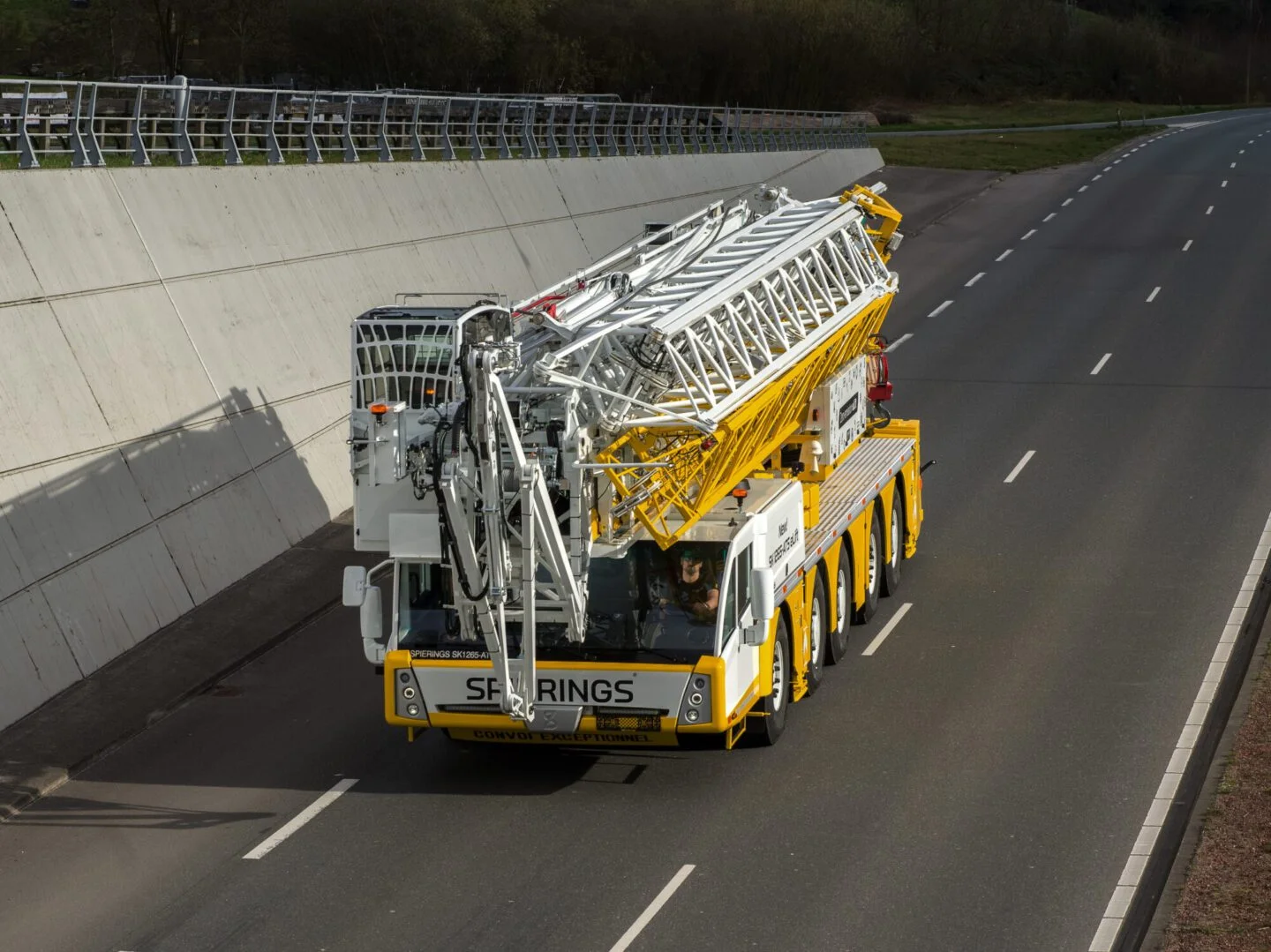
With the Spierings SK1265-AT5 eLift, this axle configuration has been deliberately optimised. As a result, the total weight is efficiently distributed across the five axles, allowing the crane to better comply with current transport regulations.
Transporting a mobile tower crane: more than simply driving
Transporting mobile tower cranes is not just about moving a crane from one location to another. It also requires careful logistical planning. Once a crane falls under exceptional transport regulations, the requirements increase and transport planning becomes more complex.
Escort vehicles, permits and route restrictions make transport less flexible. In addition, ballast also plays an important role. With many cranes, ballast has to be transported separately, requiring additional transport movements and extra permits. This not only increases complexity but also creates greater dependence on external factors within a project.
The combination of regulations and logistics clearly shows that mobility is an essential part of crane design. It is not only lifting capacity that determines how versatile a crane is, but above all its transport efficiency.
Cranes designed with efficient weight distribution, optimised axle loads and an intelligent axle configuration are better aligned with transport regulations and can therefore be deployed more flexibly. This results in fewer restrictions, fewer logistical operations and greater operational flexibility in practice.
Looking ahead: stricter regulations and future readiness
In many countries, regulations governing heavy transport are becoming increasingly strict. Restrictions relating to weight, axle loads and infrastructure are playing an ever-greater role in transport assessments.
This means that choosing a crane is increasingly becoming a long-term decision. Cranes that are already designed to meet these developments not only offer advantages today but will also remain deployable in the future.
Conclusion: mobility makes the difference
The operational flexibility of a mobile tower crane is determined not only by its lifting capacity, but above all by the way it can be transported.
A crane that efficiently manages its gross vehicle weight, remains within axle load limits and has an optimised axle configuration offers greater flexibility and fewer restrictions in daily operation.
Within this context, selecting the right configuration plays an important role. Under current or stricter transport regulations, a 5-axle configuration, such as the Spierings SK1265-AT5 eLift, offers clear advantages in terms of operational flexibility and logistics. In situations where transport restrictions are less critical, a 6-axle configuration, such as the SK1265-AT6 eLift, may be the preferred solution.
Which mobile tower crane is the right fit for your project?
Are you unsure which crane configuration best suits your project, or would you like to know which option is the best choice for your specific application? Feel free to contact us for expert advice.